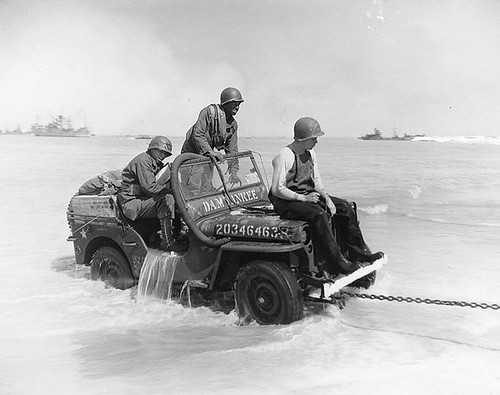
Jeep being towed ashore in Normandy Invasion, June 1944
A U.S. Army Jeep 4x4 (nicknamed "Dam Yankee") is towed ashore on a Normandy beach, 12 June 1944.
Note the amphibious operation breathing tube leading to the engine compartment, and the U.S. flag mounted on the windshield.
Two of the men with this vehicle appear to be African-Americans.
Wartime censors have deleted markings on the Jeep vehicle's front bumper, and an object in the right distance.
Taken by Combat Photo Unit Eight (CPU-8). Photo #: 80-G-252807
Official U.S. Navy Photograph, now in the collections of the National Archives.
Wednesday, May 25, 2011
Jeep assists Medal of Honor Winner
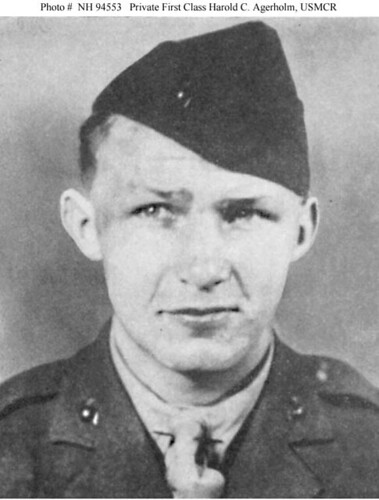
A Jeep 4x4 was instrumental in the heroic efforts of Private First Class Harold C. Agerholm, U.S. Marine Corps was posthumously awarded the Medal of Honor for his heroic efforts in single-handedly evacuating 45 casualties in an abandoned Jeep ambulance.
Agerholm tirelessly re-entered the fray in his Willys MB under heavy fire for a three hour marathon mission.
This halftone reproduction of a photograph was copied from the official publication "Medal of Honor, 1861-1949, The Navy", page 149.
Official copy reads:
"For conspicuous gallantry and intrepidity at the risk of his life above and beyond the call of duty while serving with the Fourth Battalion, Tenth Marines, SECOND Marine Division, in action against enemy Japanese forces on Saipan, Marianas Islands, 7 July 1944.
When the enemy launched a fierce, determined counterattack against our positions and overran a neighboring artillery battalion, Private First Class Agerholm immediately volunteered to assist in the efforts to check the hostile attack and evacuate our wounded.
Locating and appropriating an abandoned ambulance Jeep 4x4, he repeatedly made extremely perilous trips under heavy rifle and mortar fire and single-handledly loaded and evacuted approximately 45 casualities, working tirelessly and with utter disregard for his own safety during a gruelling period of more than 3 hours.
Despite intense, persistent enemy fire, he ran out to aid two men whom he believed to be wounded Marines but was himself mortally wounded by a Japanese sniper while carrying out his hazardous mission.
Private First Class Agerholm's brilliant initiative, great personal valor and self-sacrificing efforts in the face of almost certain death reflect the highest credit upon himself and the United States Naval Service.
He gallantly gave his life for his country."
U.S. Naval Historical Center Photograph.
Agerholm tirelessly re-entered the fray in his Willys MB under heavy fire for a three hour marathon mission.
This halftone reproduction of a photograph was copied from the official publication "Medal of Honor, 1861-1949, The Navy", page 149.
Official copy reads:
"For conspicuous gallantry and intrepidity at the risk of his life above and beyond the call of duty while serving with the Fourth Battalion, Tenth Marines, SECOND Marine Division, in action against enemy Japanese forces on Saipan, Marianas Islands, 7 July 1944.
When the enemy launched a fierce, determined counterattack against our positions and overran a neighboring artillery battalion, Private First Class Agerholm immediately volunteered to assist in the efforts to check the hostile attack and evacuate our wounded.
Locating and appropriating an abandoned ambulance Jeep 4x4, he repeatedly made extremely perilous trips under heavy rifle and mortar fire and single-handledly loaded and evacuted approximately 45 casualities, working tirelessly and with utter disregard for his own safety during a gruelling period of more than 3 hours.
Despite intense, persistent enemy fire, he ran out to aid two men whom he believed to be wounded Marines but was himself mortally wounded by a Japanese sniper while carrying out his hazardous mission.
Private First Class Agerholm's brilliant initiative, great personal valor and self-sacrificing efforts in the face of almost certain death reflect the highest credit upon himself and the United States Naval Service.
He gallantly gave his life for his country."
U.S. Naval Historical Center Photograph.


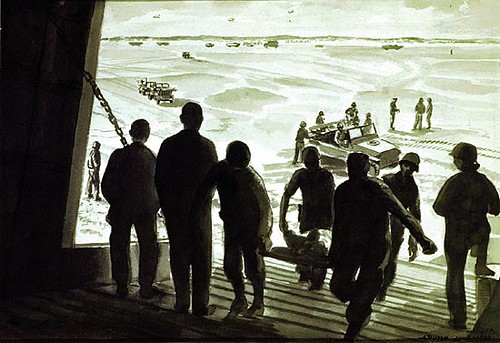
Jeep 4x4 helping evacuate wounded
Wounded taken aboard LST on D-Day.
Loading the wounded on a beached LST for transport to medical facilities in England. The wounded arrived from fighting inland on Jeep 4x4s.
Alexander P. Russo #75
Ink wash, June 1944
88-198-BW
Image courtesty of the National Archives and Records Administration.
Loading the wounded on a beached LST for transport to medical facilities in England. The wounded arrived from fighting inland on Jeep 4x4s.
Alexander P. Russo #75
Ink wash, June 1944
88-198-BW
Image courtesty of the National Archives and Records Administration.
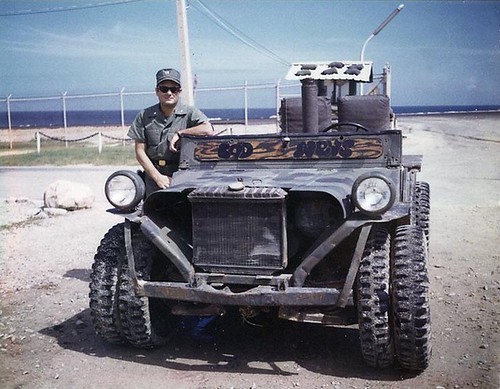
BAD NEWS Jeep Dune Buggy Viet Nam
Naval Communication Station, Cam Ranh Bay, Republic of Vietnam
Commander William J. Longhi, Commanding Officer of Naval Communication Station Cam Ranh Bay, alongside the dune buggy "Bad News". Assembled by the Station's receiver site personnel, the buggy was used to patrol the area around the receiver site.
Photographed circa 1970-1971.
Photo #: NH 106469-KN (Color). Collection of Captain William J. Longhi, USN (Retired), 2009. Uploaded to Flickr by Lee Ekstrom.
U.S. Naval History and Heritage Command Photograph.
Commander William J. Longhi, Commanding Officer of Naval Communication Station Cam Ranh Bay, alongside the dune buggy "Bad News". Assembled by the Station's receiver site personnel, the buggy was used to patrol the area around the receiver site.
Photographed circa 1970-1971.
Photo #: NH 106469-KN (Color). Collection of Captain William J. Longhi, USN (Retired), 2009. Uploaded to Flickr by Lee Ekstrom.
U.S. Naval History and Heritage Command Photograph.
Generals in a Jeep M38
General of the Army Douglas MacArthur,
Commander in Chief, Far East Command
Makes a Jeep Tour of Inchon port facilities on 16 September 1950, soon after the city was captured by U.S. forces.
Seated immediately behind him are Major General Oliver P. Smith, USMC, Commanding General, First Marine Division, (left center) and Vice Admiral Arthur D. Struble, USN, Commander, Joint Task Force Seven, (at right).
Photo #: 80-G-421945. Uploaded to Flickr by Lee Ekstrom.
Official U.S. Navy Photograph, now in the collections of the National Archives.
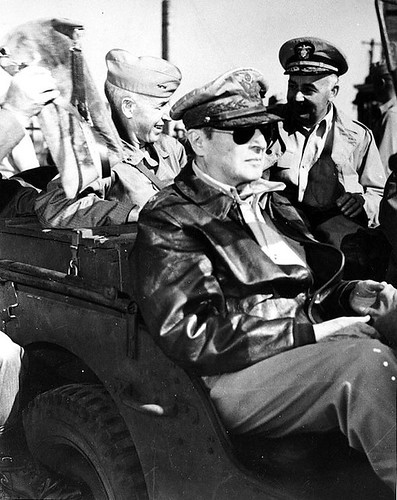
Commander in Chief, Far East Command
Makes a Jeep Tour of Inchon port facilities on 16 September 1950, soon after the city was captured by U.S. forces.
Seated immediately behind him are Major General Oliver P. Smith, USMC, Commanding General, First Marine Division, (left center) and Vice Admiral Arthur D. Struble, USN, Commander, Joint Task Force Seven, (at right).
Photo #: 80-G-421945. Uploaded to Flickr by Lee Ekstrom.
Official U.S. Navy Photograph, now in the collections of the National Archives.
Jeep Iwo Jima Landing
Jeep 4x4 in Iwo Jima Operation, 1945
"Pinned Down -- Fourth Division Marines are pinned down by enemy fire as they hit the beach at Iwo Jima on D-Day, February 19. Making their fourth amphibious assault in 13 months, the veteran fighters are ready to secure the right flank of the initial beachhead.'"
Quoted from the original picture caption released for publication on 25 February 1945 by Commander in Chief, Pacific.
The landing ship in the background (with its bow and stern numbers censored) is LSM-206.
Note broached LCM in the center, and swamped jeep and LCVP (also with identification markings censored) at right.
The original photograph came from the illustrations package for Rear Admiral Samuel Eliot Morison's "History of United States Naval Operations in World War II", volume XIV: "Victory in the Pacific".
The photo was provided to Morison by E.J. Long. It was uploaded to Flickr by Lee Ekstrom.
Photo #: NH 65312.
Official U.S. Marine Corps Photograph, from the collections of the Naval Historical Center.
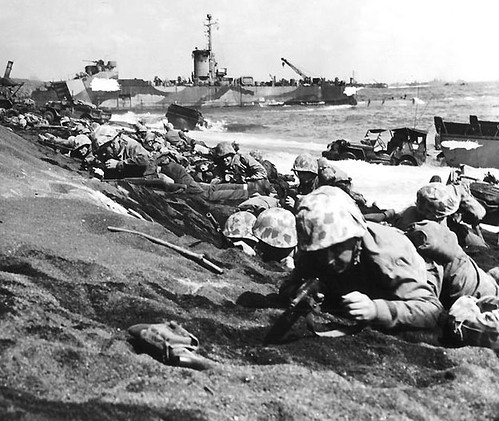
"Pinned Down -- Fourth Division Marines are pinned down by enemy fire as they hit the beach at Iwo Jima on D-Day, February 19. Making their fourth amphibious assault in 13 months, the veteran fighters are ready to secure the right flank of the initial beachhead.'"
Quoted from the original picture caption released for publication on 25 February 1945 by Commander in Chief, Pacific.
The landing ship in the background (with its bow and stern numbers censored) is LSM-206.
Note broached LCM in the center, and swamped jeep and LCVP (also with identification markings censored) at right.
The original photograph came from the illustrations package for Rear Admiral Samuel Eliot Morison's "History of United States Naval Operations in World War II", volume XIV: "Victory in the Pacific".
The photo was provided to Morison by E.J. Long. It was uploaded to Flickr by Lee Ekstrom.
Photo #: NH 65312.
Official U.S. Marine Corps Photograph, from the collections of the Naval Historical Center.
Jacklyn Lucas Medal of Honor in Jeep
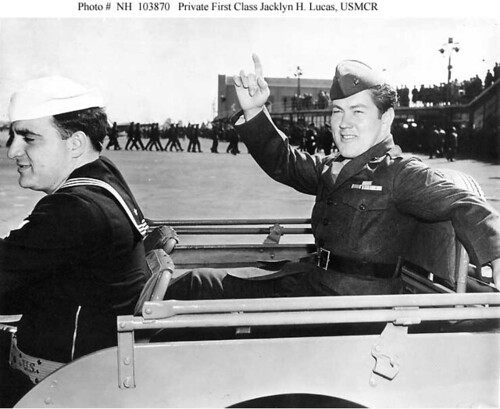
Private first Class Jacklyn H. Lewis of the U.S. Marine Corps - was awarded the Medal of Honor for pulling two grenades under his body to protect his fellow soldiers.
Read more of his exploits at en.wikipedia.org/wiki/Jacklyn_H._Lucas
Jacklyn waves from the back seat of a Willys MB Jeep 4x4 as he leaves LaGuardia Airport for Nimitz Day celebrations in New York City, New York on 9 October 1945.
Photo #: NH 103870.
Collection of Fleet Admiral Chester W. Nimitz, USN.
U.S. Naval Historical Center Photograph.
Read more of his exploits at en.wikipedia.org/wiki/Jacklyn_H._Lucas
Jacklyn waves from the back seat of a Willys MB Jeep 4x4 as he leaves LaGuardia Airport for Nimitz Day celebrations in New York City, New York on 9 October 1945.
Photo #: NH 103870.
Collection of Fleet Admiral Chester W. Nimitz, USN.
U.S. Naval Historical Center Photograph.
Subscribe to:
Posts (Atom)