Check out these amazing videos of the Tucker Combat Vehicle
(TCV). It certainly has many features that were advanced for the World War II
era. If you’ve seen Francis Ford Coppola’s movie “Tucker: the man and his dream”
– you’ll realize the man was a genius of design and innovation.
Tucker saw that war was on the horizon in Europe and began
designing for a high-speed armored combat vehicle as early as 1939. Tucker was
born in 1903 on a Michigan peppermint farm. Tucker returned to Michigan and worked
out of a barn in Ypsilanti to develop his ingenious inventions.

Some of his
unique creations include the use of individual wheel brakes – what we refer
today as Antilock Brakes or Brake Lock Differentials (03:54 mark), arc welded steel armor plate (00:08), same-size swappable bulletproof windows (00:28 mark), air
conditioning in the battlefield (09:21), bulletproof and multi-chambered radiator (01:25 mark), adjustable headlights (00:53), and a V-style hull to protect gas tank (10:09).

The Tucker Combat Car also had one of the most wicked camo paint jobs around.
Highlights from the 1942 video clip regarding the Tucker
Combat Vehicle:

“It is constructed entirely of steel armor plate, welded
together by a new method which completely eliminates all riveting.
“Large windshield and windows of bulletproof glass afford
exceptionally wide and unobstructed vision and can withstand heaviest machine
gun fire.
“All windows are of one size and instantly changeable.
“Specially designed headlamps, also of bulletproof glass, are
capable of throwing a beam one mile and are individually adjustable so as to be
usable as searchlights.
“Quickly removable hood gives complete accessibility to
engine.
“The bulletproof radiator shield is so designed that it need
not be closed. Each section can be instantly replaced when damaged.


“The Combat Car is capable of speeds in excess of 100 miles
per hour on paved highways and 65 miles per hour over rough terrain.
“Because of advanced chassis construction, it can withstand
heaviest strains and shocks of rough terrain.

“Its low center of gravity assures perfect stability up to 45
degrees tipping angle.
“Individual wheel brakes eliminate spinning wheels.

“The Combat Car is armed with a forward battery of three
machine guns and an American Armament of 37-mm. anti-aircraft gun or anti-tank
gun, mounted in a revolving turret.

“This armament is capable of laying down a withering fire at
the combined rate of 2,820 shots a minute.

“The turret gun has a 360°
traverse and a 75°
angle of elevation.

“The unit can also be furnished with electric controls in
place of, or in addition to, manual elevating and traversing controls. The
electric device has a speed range from creeping motion to 360° in
4.6 seconds.
“It is fully automatic and fires 37-mm. explosive projectiles
against airplanes or armor-piercing projectiles against tanks.
“Bracketing and hitting aerial targets. Note tracer which
indicates path of projectile.
“Demonstrating efficiency of its armor-piercing projectiles
against steel armor plate.
“Perfect visibility enables drivers to avoid tank traps and
defenses.”
“Forced air conditioning eliminates crew discomfort and
dangers of flame attack.”

“Perfect spring suspension affords maximum riding comfort
and stability, assuring high accuracy of fire while in motion.”

“The crew is fully protected against any explosion of the
gasoline tank by heavy armor plate and by a device which directs the force of
explosive outward.”
“Engine compartment louvres are so placed as to act as
windshield defrosters.”
“The Combat Car has a 12-inch clearance and its bottom is
completely armor plated against bombardment or damage from attacks.”

“The unit has provisions for dual rear wheels, four-wheel
drive and caterpillar tracks.”

“A fleet of Combat Cars at Rahway plant, fully tested and
ready for delivery.”
Testing of the TCV was done at the Rahway, New Jersey
factory owned by the
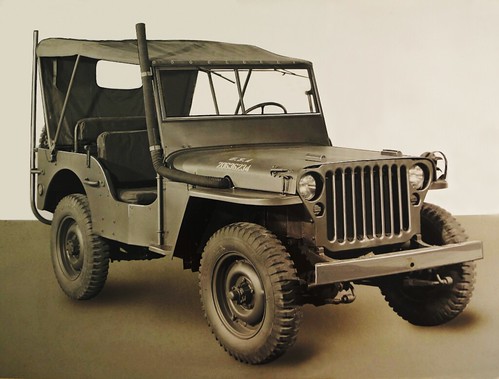
American Armament Corporation. Harry Miller, a Tucker
employee would take some of Tucker’s suspension designs and apply them at
Bantam where he helped in the development of the first Jeep prototype vehicle.
Sadly Tucker’s original fast-moving armored car design
wasn’t mass-produced because the Belgian government that commissioned his
services was invaded by the Nazis before production could begin. The U.S.
Military rejected the concept because it was too fast to be safe. In addition
the contracts were already awarded by the time they tested the vehicle.

According to LEF magazine His revolutionary plexi-glass gun turret that was eventually used on the B-17
Flying Fortress, the B-24 Liberator and other American bombers. The “Tucker
Turret” was even used by the Navy on many of its PT boats and landing ships.